


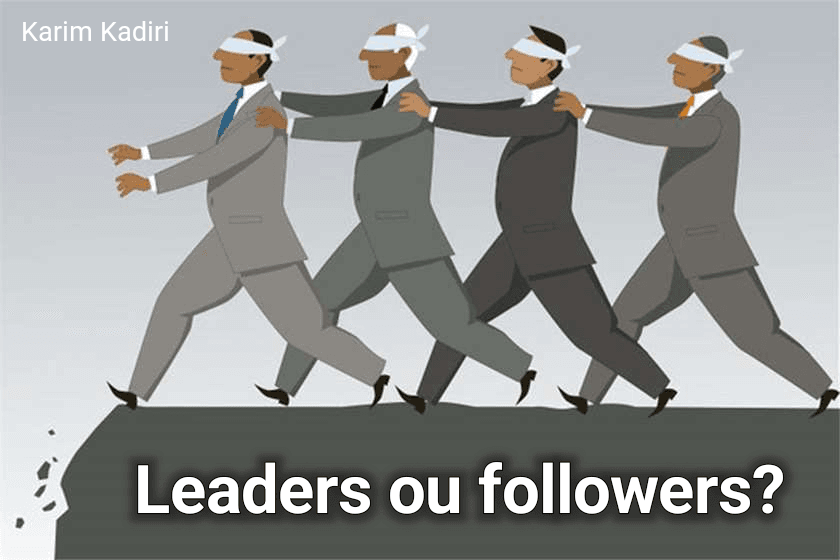
I increasingly get the impression that authenticity is no longer the path most likely to lead to success in our society. On the contrary, conformity—which I personally reject—often seems to be the safer and more rewarding choice. Following the crowd appears to be valued more than individuality, originality, or the courage to challenge convention.
Our standards of behavior, dress, and even the language we’re expected to use in society are largely predetermined. Whether it’s a birthday, a wedding, a funeral, or any other social occasion, what we are supposed to say and do has already been written for us. Failing to follow these unwritten rules often risks being misunderstood—or even becoming an outsider in the eyes of others.
It is worth remembering, however, that excellence and innovation have never come from the crowd.
The scientists, poets, philosophers, and visionaries who shaped the world we live in all had the courage to break away from tradition and challenge the customs of their time. People like Elon Musk, Albert Einstein, or Louis de Funès never feared being different or being ridiculed. They simply dared to be themselves because no one else would have believed in their dreams.
Two Different Paths
Today, perhaps we should ask ourselves a few important questions.
Do we want clones and executors, or do we want innovators?
Do we want leaders—or followers?
Should we celebrate conformity or originality?
Numerous studies have shown that the fear of criticism is one of the most paralyzing fears we experience. Cemeteries are filled with people who never truly expressed themselves and therefore never had the opportunity to contribute their unique ideas to humanity.
The problem becomes even greater when, while still alive, we stop asking questions altogether.
We simply accept the status quo, assuming someone else must know why things are done the way they are.
In reality, very few people know where many of our modern workplace and social traditions actually come from. Most simply imitate those who came before them, who themselves copied the previous generation, and so on.
In English, there’s an expression for this:
“The blind leading the blind.”
Everyone hopes someone knows where they’re going.
You can hear this pattern in much of the popular music produced over the past two decades. Many mainstream songs—whether pop, Gnawa, or Raï—often sound remarkably similar. The same can be said for countless music videos on channels such as Rotana. Their overall style is strikingly alike, and the themes rarely change: love, beauty, and luxury cars.
Returning to my opening thought, perhaps these artists are simply being pragmatic.
They understand that reinventing the wheel is incredibly difficult, while reproducing formulas that already appeal to the masses is faster and far more profitable.
They have also realized that dedicating years to creating works of art appreciated by only a small, highly selective audience may not be financially sustainable.
Life is difficult enough without sacrificing financial stability for principles alone.
The same repetition can be observed in television.
Advertisements continue to use an artificial mix of Classical Arabic and dialect that hardly anyone speaks naturally. Politicians persist in delivering speeches in formal Arabic that many ordinary citizens struggle to understand. Children’s television programs have changed very little since my own adolescence over forty years ago.
The corporate world follows similar patterns.
Whenever companies want to improve their performance, the same words are endlessly repeated:
Targets. Budgets. End-of-month figures. Procedures. Processes. Prices.
What I rarely hear is something much more important:
Serve people exceptionally well.
Very few Moroccan companies make what I consider to be the most powerful marketing investment possible:
Creating genuinely happy customers who naturally become ambassadors for the business.
Regardless of the industry, advertising usually consists of little more than a picture of the product and its price. Stimulating curiosity or creating an emotional connection seems to have gone out of fashion.
Even religious expression has, in many ways, become more visible.
Until the 1980s, before I left Morocco, prayer was largely a private matter and was rarely seen in the workplace. Today, many companies have dedicated prayer rooms, as do shopping malls, airports, train stations, and other public spaces.
Many Muslims now visibly display a prayer mat in their office or car. Likewise, the hijab was far less common during that period, as were long religious beards. Today, in certain neighborhoods, it is difficult to find a woman who is not wearing a headscarf.
Some Questions
Are there more Muslims in Morocco today, or are religious practices simply more visible than they once were?
If the religion itself has not changed, why have our religious habits changed so significantly?
The same applies to fashion.
Many people simply dress like everyone else. Even at a young age, the fear of standing out and the desire to belong often lead us to blend into the crowd instead of expressing our individuality.
Human beings naturally gravitate toward those who resemble them and share their values.
For anyone seeking social acceptance or professional advancement, conformity can therefore be the easier path.
Being different, original, or truly unique can also be rewarding—but it demands far greater courage, perseverance, and strength of character.
Fortunately, throughout history, some people have chosen that more difficult path.
They challenged convention so that the rest of us could enjoy a world enriched by technological progress, medical breakthroughs, and artistic achievement.
Without their rebellious spirit and their willingness to swim against the current, we might still be living in the Stone Age.
Your feedback is always welcome.
— Karim Kadiri
May 23, 2022